Independent damp & timber surveys · All of England
We read walls.
Then we tell you the truth about them.
Rising damp, penetrating damp, condensation and rot all leave different marks on an English wall. Most are misdiagnosed by whoever is quoting for the treatment. We survey first, we don't sell chemicals, and the report is yours to act on.
- Surveys by PCA-certificated surveyors
- Independent survey, no tie to a contractor
- Insurance-backed guarantees
- Reports accepted by lenders & solicitors
- Covering the whole of England
Three problems, one symptom
Damp is a diagnosis, not a product.
A tide mark on a Victorian terrace wall can be four different things. Injecting a chemical damp-proof course fixes exactly one of them. This is what we're separating when we survey.
Groundwater rising by capillary action
Rising damp
Genuinely uncommon, and over-diagnosed for fifty years. It stops at a horizontal tide line, usually under a metre, and carries ground salts that bloom through the plaster. On solid stone walls the cause is often a raised external ground level, a bridged DPC, or a blocked sub-floor vent — not a failed course.
Water crossing the wall from outside
Penetrating damp
The most common cause of a damp English wall. Cracked pebbledash, cement render trapping moisture in a lime-built wall, failed pointing, a leaking downpipe, a slipped tile, a defective chimney flashing. It appears at the point of failure and worsens after rain rather than following the seasons.
Moisture produced inside the building
Condensation & mould
Black spot mould in corners, behind furniture, on cold reveals and single-glazed margins. It is a heating, ventilation and cold-bridging problem, and no chemical treatment will touch it. This is the category most often reported by tenants, and the one Awaab's Law is written around.
Evidence, not opinion
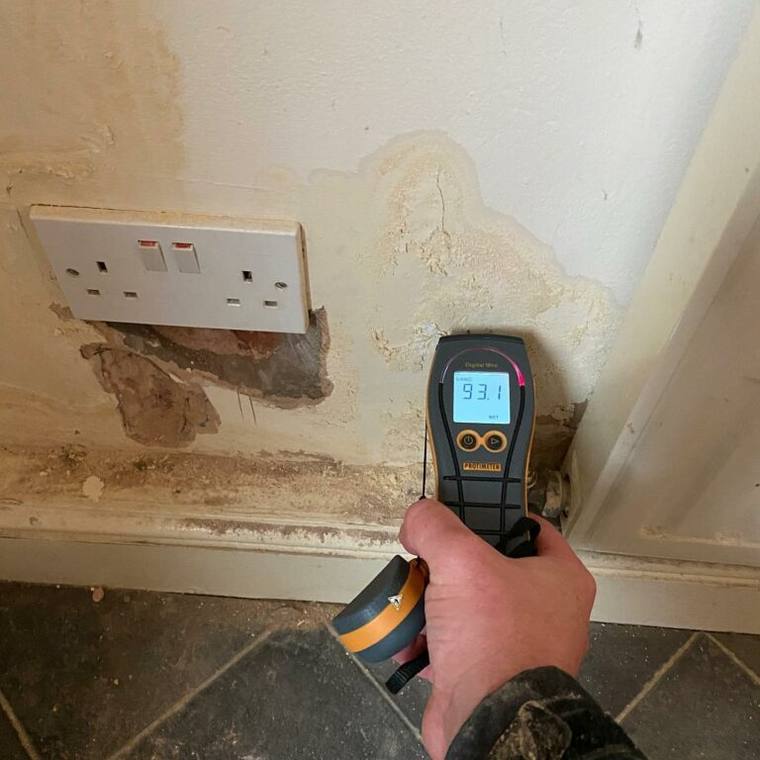
A number on a meter is not a diagnosis.
That reading tells you the wall is wet. It does not tell you why, and a conductivity meter will read salt, foil-backed board and metal lath just as enthusiastically as it reads water.
What turns a reading into a diagnosis is the pattern across the elevation, the height it stops at, whether it worsens after rain or in winter, the salts in the plaster, and what the outside of that wall is doing. That is the work. The meter is just where it starts.
What we do
Independent damp survey
Full moisture profile, salts analysis where needed, external defect inspection, photographic report with a costed schedule of works.
02 · SurveyTimber decay inspection
Dry rot, wet rot and woodworm. Joist ends, plate rot, sub-floor timbers, roof spaces and the hidden extent behind the plaster.
03 · SurveyMortgage valuation retention
Where a mortgage valuation or RICS survey flags dampness and the lender holds back funds, we produce the specialist report that releases it.
04 · WorksDamp remedial works
Chemical DPC installation where it is genuinely warranted, salt-retardant re-plastering, lime plaster reinstatement, external repairs.
05 · WorksRot & woodworm treatment
Irrigation and masonry sterilisation, timber replacement and resin repair, targeted insecticidal treatment where an active infestation is confirmed.
06 · ComplianceLandlord damp & mould reports
Investigation reports written to satisfy Awaab's Law and the Homes (Fitness for Human Habitation) Act 2018, with a written summary for the tenant.
The law is already changing
Awaab's Law is live — phase two lands 30 November 2026.
Since 27 October 2025, social landlords in England have had fixed, countable timescales for investigating and fixing damp and mould. Phase two widens the hazards covered and tightens the clock further. Private landlords aren't covered yet — but an extension is under government consultation, so getting ahead of it now is the smart move.
Until phase two commences.
The 10 · 3 · 5 rule
- 10WORKING DAYS
Investigate
From the point the landlord becomes aware a property may be affected by damp or mould — by tenant report, inspection, or any other means.
- 3WORKING DAYS
Write to the tenant
A written summary of what the investigation found, due within three working days of the investigation being completed.
- 5WORKING DAYS
Start the work
Where the investigation concludes work is needed, it must commence within five working days of that conclusion.
If a timescale can't be met, the landlord must set out in writing why, and when they will comply. General guidance only — see the full note on the landlords page.
Why we charge for the survey
A free survey is a sales visit.
If the person diagnosing your wall is paid only when you buy the treatment, there is exactly one diagnosis they can afford to reach. That is how thousands of English homes ended up with an injected damp-proof course they never needed, in walls where the real fault was a cracked downpipe two floors up.
We charge a survey fee and we tell you what is wrong, including when the answer is "nothing that needs us". You are free to take the report to any contractor you like. If you want us to carry out the works, the survey fee comes off the price.
Survey fees start at — for a single property inspection. Confirmed in writing before we attend, along with your 14-day cancellation rights where the contract is agreed at your home.
Coverage
The whole country, and we know what it's built from.
Victorian brick terraces in the Midlands and the North, 1930s cavity-wall semis in the suburbs, timber-framed cottages in the South East, Cotswold stone further west. The building stock changes every fifty miles and so does the failure mode.
- London
- Manchester
- Birmingham
- Leeds
- Liverpool
- Sheffield
- Bristol
- Nottingham
- Leicester
- Newcastle
- Southampton
- Coventry
- Bradford
- Stoke-on-Trent
- Wolverhampton
- Plymouth
- Derby
- Reading
- Brighton
- York
- Oxford
- Cambridge
Common questions
Before you call anyone.
Including us. Half of what gets reported as damp is a maintenance job that costs a fraction of a specialist's quote.
Almost certainly not, if the staining is above a metre, appears after heavy rain, sits below a window or beside a chimney breast, or shows as black spot growth in a corner. True rising damp is limited, stops at a defined tide line and brings hygroscopic salts with it. We test for those salts rather than relying on a meter reading alone — a protein meter reads conductivity, and salt, foil-backed plasterboard and metal lath all read as "damp".
A mortgage valuation or RICS HomeBuyer Report/Building Survey may note dampness and recommend a specialist report. Lenders frequently apply a retention until that report is produced. A specialist damp and timber report with a costed schedule is normally what releases it, and it is far cheaper to hold that report before the offer than to renegotiate after it.
Very common, and it changes who pays. Where the defect is in a shared roof, external wall or communal downpipe, repairs are usually decided and apportioned under the lease, and for the shared parts by the freeholder's or management company's repairing obligations. A landlord's own repairing duty under the Landlord and Tenant Act 1985 doesn't evaporate because the defect is in common parts. Our report identifies the defect and its location precisely, which is what your freeholder, managing agent or other leaseholders will need before anyone agrees to pay.
Report it in writing and keep the date. If you're in social housing, your landlord has duties under Awaab's Law — fixed timescales for investigating and fixing damp and mould, in force since 27 October 2025. All landlords have a repairing duty under the Landlord and Tenant Act 1985, and councils can assess damp as a hazard under the Housing Health and Safety Rating System. If the landlord does not comply you can complain to the Housing Ombudsman Service (social housing) or your local council's environmental health team, who can serve an Improvement Notice. Free independent advice is available from Shelter and Citizens Advice — we survey buildings, we are not a tenancy advice service.
We also run DampCheck England, a free tool for tenants in England: a symptom checker that helps you work out what you are actually looking at, and a letter generator that puts your report to the landlord in writing with a date on it. No charge and no sign-up.
Typically 60 to 120 minutes on site for a flat or standard house, longer for a full building. You receive a written report within — working days: moisture readings plotted room by room, photographs of every defect, the diagnosis with our reasoning, and a schedule of works separated into what is urgent, what is remedial and what is maintenance you can hand to a joiner or roofer.
Recent work
Hacked off, treated, replastered.
Remedial damp work is disruptive and there is no honest way to pretend otherwise. Walls come off to a metre above the highest reading, the masonry is treated, and it goes back in a salt-retardant render. This is what that looks like.
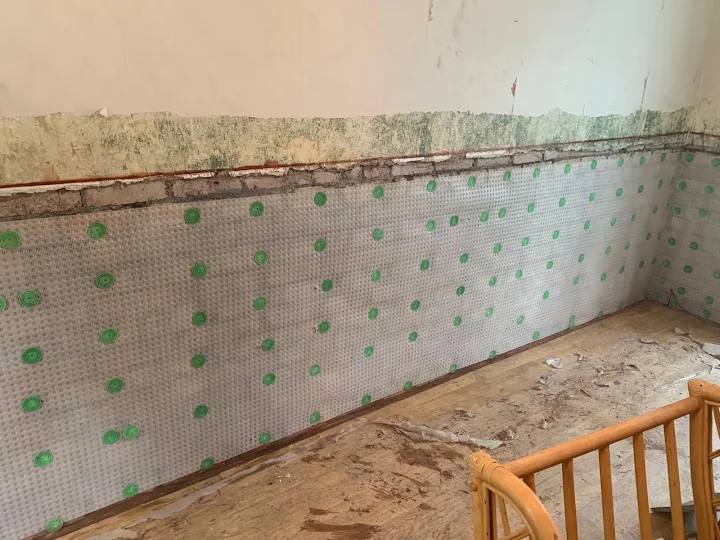
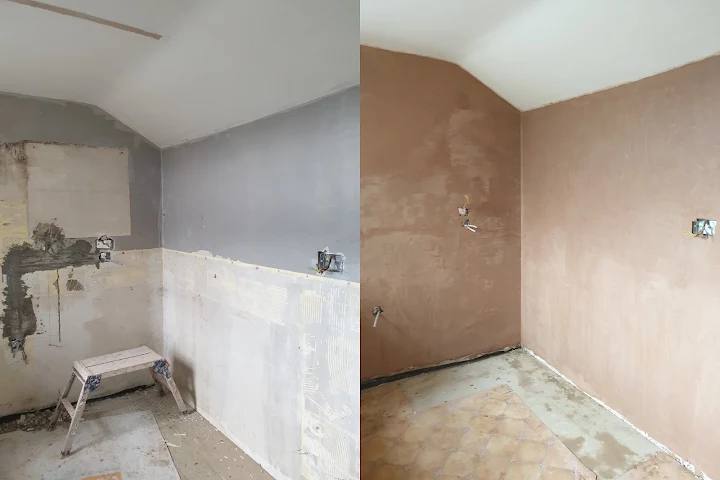
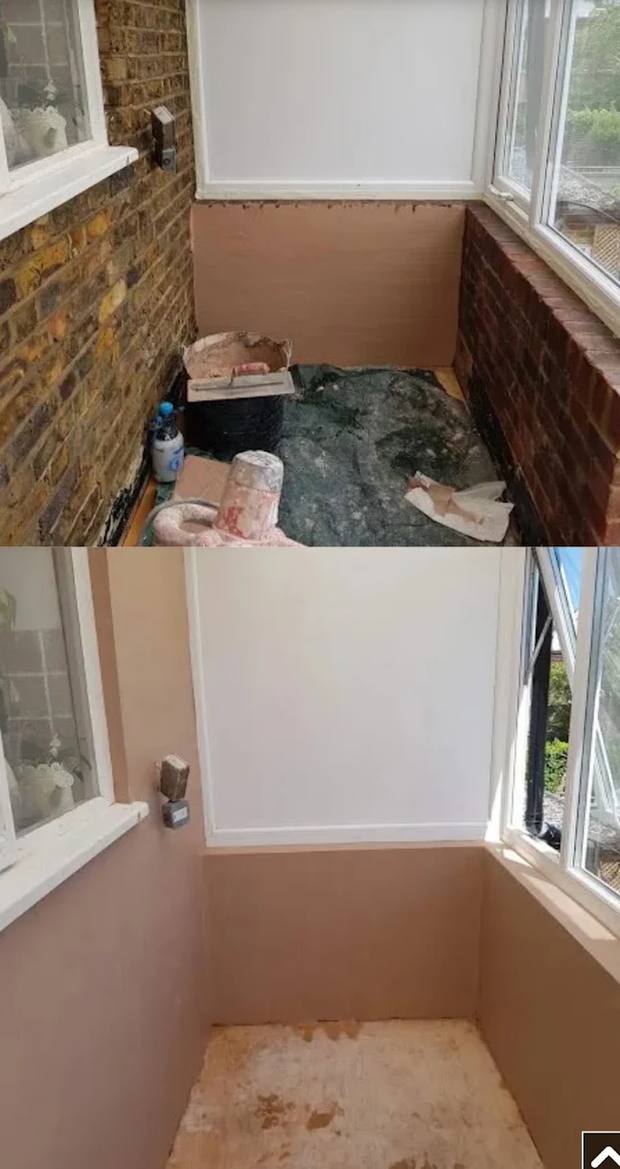
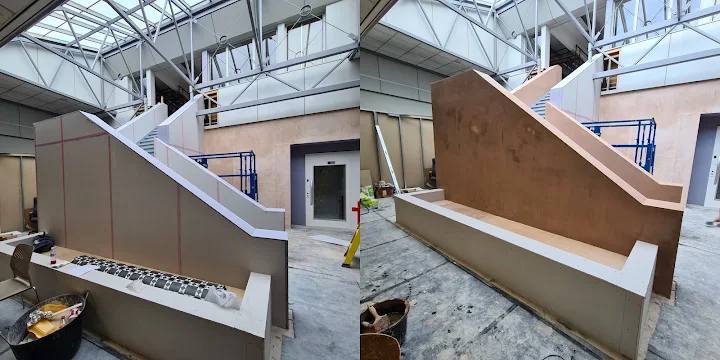
Photographs are of our own previous damp and timber contracts. English project photography will replace these as work completes.
Find out what's actually wrong.
Tell us what you're seeing. Five questions, no phone call until you want one.